
You switched from biscuits to granola. You stopped ordering fries. You even started eating nuts every morning because everyone says they’re healthy.
And yet, the weighing scale isn’t exactly impressed.
Frustrating? Absolutely.
Here’s the slightly uncomfortable truth: a food can be nutritious and still add a surprising number of calories to your day. “Healthy” and “low-calorie” aren’t synonyms. Your body doesn’t hand out bonus points because the calories came from something labelled organic, natural, or homemade.
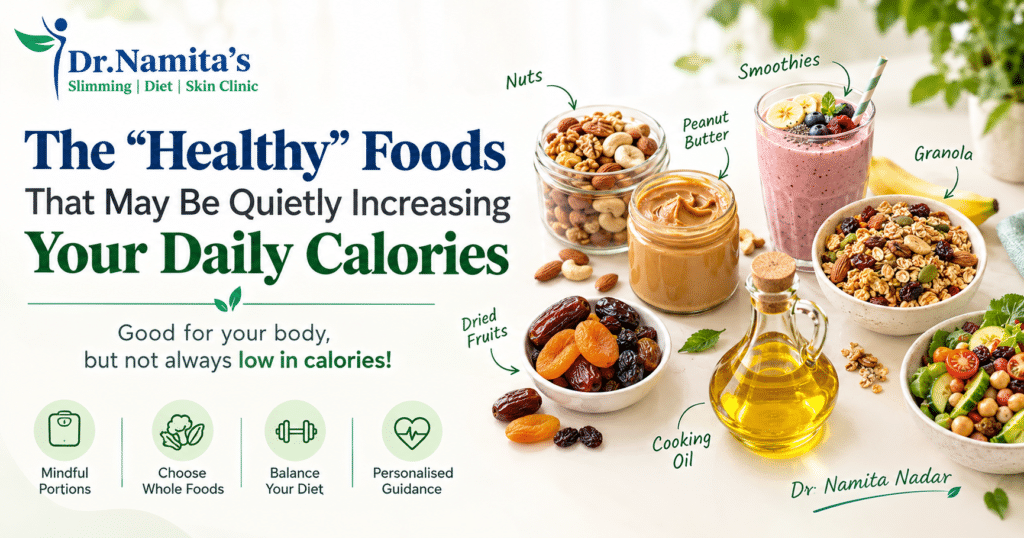
Take nuts. Almonds, walnuts and cashews contain healthy fats, protein and several important nutrients. Great foods. But a handful can quietly become two handfuls while you’re working, watching television or scrolling through your phone—and suddenly that casual snack has turned into a fairly substantial addition to your daily intake.
Then there’s peanut butter.
One spoon becomes two. Two becomes a generous scoop because, well, who’s measuring peanut butter? It contains useful fats and protein, but portion size matters. Eating it straight from the jar makes that portion very difficult to notice.
Smoothies can play the same trick.
You put banana, mango, dates, milk, peanut butter and perhaps a little honey into the blender. It looks innocent. It sounds healthy. It tastes fantastic. But you’ve basically turned several individual foods into one very easy-to-drink calorie package.
Drinking calories is sneaky.
Your brain may register a glass of smoothie as a drink rather than a meal, even though the ingredients could provide considerable energy. That doesn’t make smoothies “bad”; it simply means they need to fit into your overall diet.
Granola is another classic example.
It often arrives wearing a health-food costume—oats, nuts, seeds, dried fruit and perhaps honey or jaggery. But some versions contain added sugars and oils, and portion sizes can be much smaller than the amount people casually pour into a bowl.
Then there are dried fruits.
Raisins, dates, dried figs and apricots can provide fibre and micronutrients, but removing water concentrates the food. Eating several dates takes seconds. Eating the equivalent amount of fresh fruit usually feels much more substantial.
Even something as innocent as cooking oil deserves attention.
A vegetable sabzi may be packed with vegetables, but the oil used during cooking still contributes calories. A healthy ingredient doesn’t cancel out the energy coming from another ingredient.
So what should you eat?
Don’t start eliminating everything.
The better approach is to build meals around foods that offer plenty of volume and nutrition without making portions difficult to manage—vegetables, whole fruits, pulses, lean protein, whole grains and appropriately measured sources of healthy fats can all play a role.
This is where personalised guidance matters. The right diet isn’t simply a list of foods labelled “healthy”. It should consider your routine, preferences, activity levels, medical needs and actual eating habits.
Dr Namita Nadar focuses on practical nutrition rather than making food unnecessarily complicated. The goal is not to fear nuts, fruit, smoothies or peanut butter. It’s to understand portions and balance them intelligently.
Because healthy eating shouldn’t feel like a courtroom where every almond is evidence against you.
Balance.
When choosing healthy foods for weight loss, look beyond the label. Ask a simpler question: How much am I actually eating, and does it fit my day?
That small shift can change the entire way you look at food.